HSN and SAC Codes Explained: GST Rates, Digit Rules, and Examples
If you bill under Indian GST, sooner or later a client's accounts team will bounce your invoice with one line: "HSN code missing." This guide explains what HSN codes and SAC codes actually are, who must print them, how many digits you need, and the fastest way to stop thinking about them entirely — storing the code once on a catalog item so every future GST invoice carries it automatically.
HSN vs SAC in plain language
- HSN — Harmonized System of Nomenclature. A worldwide classification for goods, maintained by the World Customs Organization and used by 200+ countries. India adopted it for GST. Example:
6109covers t-shirts and vests. - SAC — Services Accounting Code. India's classification for services, always starting with
99. Example:998314is IT design and development services.
The point of both: the tax department wants to know what was sold without reading your item descriptions. The code, not your wording, decides which GST slab applies.
How many digits do you need?
| Aggregate turnover (previous FY) | HSN digits required | Where |
|---|---|---|
| Up to ₹5 crore — B2B invoices | 4 digits | Tax invoice |
| Up to ₹5 crore — B2C invoices | Optional (4 digits recommended) | Tax invoice |
| Above ₹5 crore | 6 digits | All invoices + GSTR-1 |
| Imports / exports | 8 digits | Customs documents |
SAC codes for services are always quoted at 6 digits. When in doubt, more digits are never wrong — a 6-digit code satisfies a 4-digit requirement.
Common HSN and SAC codes freelancers and small businesses use
| What you sell | Code | Typical GST rate |
|---|---|---|
| IT / software development services | SAC 998314 | 18% |
| Graphic design services | SAC 998391 | 18% |
| Advertising / marketing services | SAC 998361 | 18% |
| Readymade garments (sale value ≤ ₹1000) | HSN 61/62 chapters | 5% |
| Books (printed) | HSN 4901 | 0% |
| Mobile phones | HSN 8517 | 18% |
| Furniture (wooden) | HSN 9403 | 18% |
| Restaurant / catering services | SAC 9963 | 5% (without ITC) |
Rates change in GST Council meetings — treat this table as a starting point and verify your exact item on the official CBIC portal before filing.
Where the code goes on your invoice
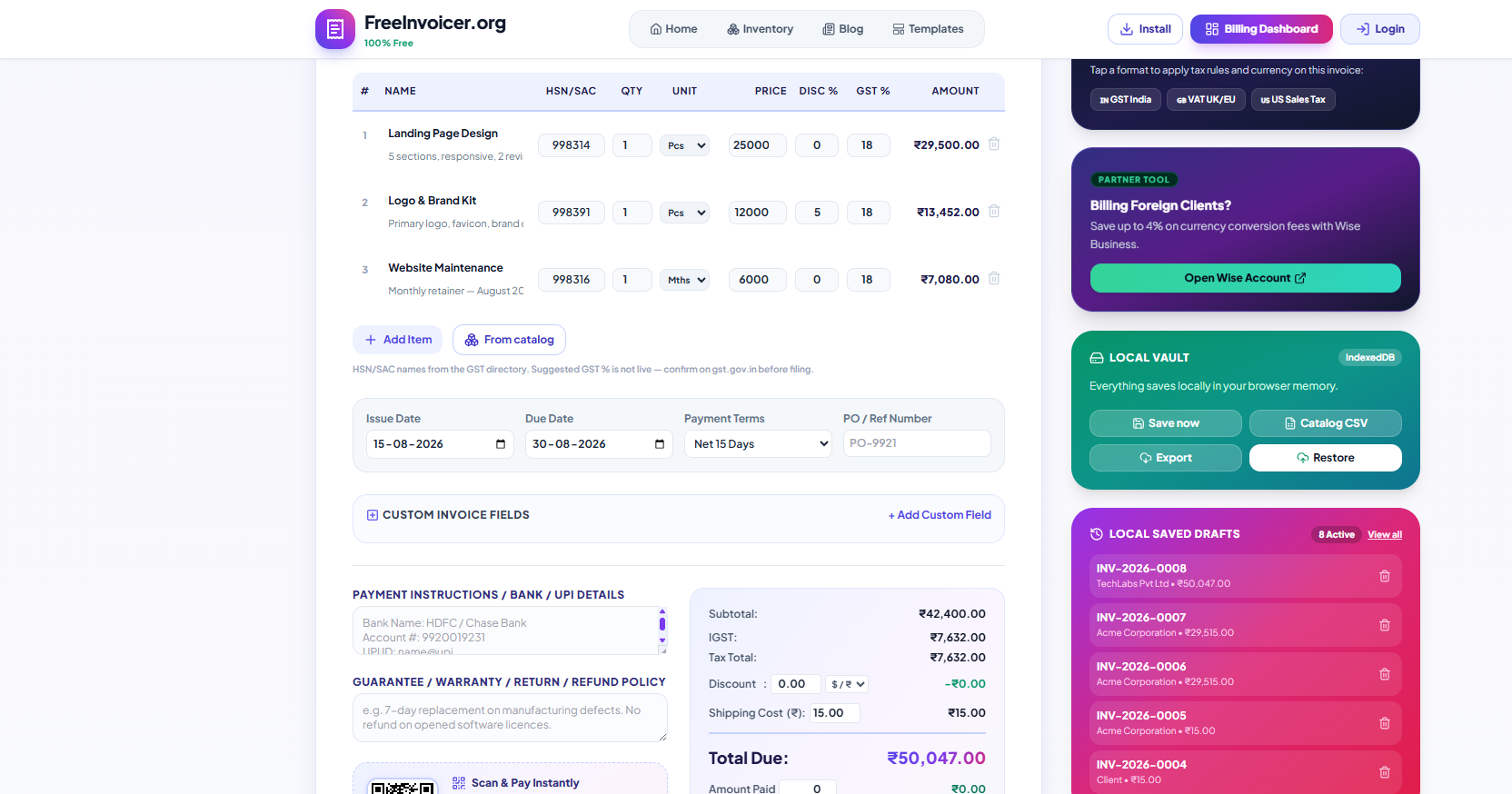
In the editor, every line item has an HSN field right next to the description. Type the code once and it appears in your records for that document. Two habits make this painless:
- Save items in Inventory. Open Inventory from the top menu, add your product or service with its HSN/SAC, default rate, unit, and GST percentage. Inserting the item on any future invoice brings the code with it — no memory required. The SKU guide shows this in detail.
- One code per line, not per invoice. Selling a laptop (HSN 8471, 18%) with a carry bag (HSN 4202, 18%) and installation (SAC 998719)? Three lines, three codes. The editor totals each tax rate correctly on the same document.
What happens if you skip or botch the code?
- Input credit friction. Registered buyers reconcile purchases in GSTR-2B; invoices with missing codes get queried, and queried invoices get paid late.
- Penalties. Incorrect or missing HSN details can attract a penalty per act (commonly cited at ₹25,000 under CGST + ₹25,000 under SGST for incorrect invoicing). Rare for small sellers, but not worth testing.
- Wrong rate, wrong price. The code determines the slab. Classify a 5% item as 18% and you overcharge your client; the reverse and the shortfall comes out of your pocket at filing time.
HSN summary in GST returns
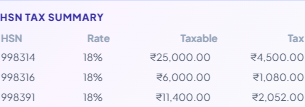
GSTR-1 asks for an HSN-wise summary of outward supplies — total quantity, taxable value, and tax per code. If your invoices carry codes on every line, this summary is a copy-paste job. If they do not, it becomes an end-of-month archaeology project. This is the single best argument for putting codes on invoices from day one, even when your turnover makes them technically optional.
How to find the right code for your product
There is no single magic lookup, but this three-step routine settles most cases in under five minutes:
- Start with the CBIC GST rate finder. Search your product's common name on the official portal and note the chapter heading it falls under. Chapter (first 2 digits) → heading (4 digits) → sub-heading (6 digits) — you are drilling down a tree, not memorising a list.
- Check what your suppliers use. Look at the purchase invoices you receive for the same or similar goods. If three suppliers all classify the item under one code, that is strong evidence of accepted practice in your trade.
- Confirm the rate matches reality. If the code you found implies 12% but everyone in your market charges 18%, dig deeper before assuming the whole market is wrong — there is often a notification or condition attached to the lower rate.
Once settled, write the decision down somewhere permanent. The best "somewhere" is the catalog item itself — code, rate, and description together — so the research never has to be repeated by you or anyone who helps with your billing later.
HSN codes in e-invoicing and e-way bills
As your business grows, the same codes feed two more systems. E-invoicing (mandatory above the notified turnover threshold) validates the HSN on every line against the government schema — an invalid code means the invoice reference number is simply not generated, and dispatch stops. E-way bills for goods movement also carry HSN codes, and mismatches between the e-way bill and the invoice are a favourite check at interception points. The lesson is the same one this whole article makes: get the code right once, at the catalog level, and every downstream document inherits correctness for free.
Quick answers
Is HSN needed on a quote?
Not legally, but including it on a quotation signals that the final invoice will be clean, which procurement teams appreciate.
My product fits two codes — which do I pick?
Use the code matching the product's essential character, and stay consistent. If genuinely ambiguous, your GST practitioner can request an advance ruling.
Do unregistered sellers need HSN?
No — HSN requirements apply to GST-registered businesses issuing tax invoices. Unregistered sellers issue a bill of supply style document without tax.
Do HSN codes ever change?
The codes themselves are stable, but the rates attached to them move with GST Council decisions, and India periodically syncs with the World Customs Organization's revisions. Once a year — ideally before filing season — spend ten minutes re-checking the rates on your top catalog items. Update the item once and every future invoice inherits the correction.
Keep reading: the freelancer invoice checklist covers every field a compliant invoice needs, and the templates guide shows how the codes render on each A4 design.