SKU vs HSN on an Invoice: Product Codes Explained (+ Free Inventory Catalog)
Two codes show up around products on Indian invoices, and mixing them up causes real confusion: the SKU, which is your code for your tracking, and the HSN code, which is the government's code for tax classification. This guide explains what a SKU on an invoice actually does, how to design SKU codes that scale past twenty products, and how the built-in Inventory catalog in Free Invoice Generator turns repeat billing into a two-click job.
SKU in plain language
A SKU (Stock Keeping Unit) is a short code you invent to identify one specific sellable thing — down to the variant. A medium black t-shirt and a large black t-shirt are one product but two SKUs, because you need to know which one left the shelf:
TEE-BLK-M— t-shirt, black, mediumTEE-BLK-L— t-shirt, black, largeWEB-LAND-STD— even services can have SKUs: standard landing page package
Nobody assigns SKUs to you and no law requires them. They exist purely so that you, your staff, and your records all point at exactly the same item without ambiguity.
SKU vs HSN: the comparison that clears it up
| SKU | HSN / SAC | |
|---|---|---|
| Who defines it | You | World Customs Organization / GST law |
| Purpose | Track your stock and variants | Classify goods/services for tax |
| Granularity | Per variant (colour, size, package) | Per product category |
| Required on a GST invoice | No — optional but useful | Yes, above turnover thresholds |
| Example | TEE-BLK-M | 6109 (all knitted t-shirts) |
Notice the granularity row: a hundred of your SKUs can share one HSN code. Every t-shirt you sell — any colour, any size — classifies under HSN 6109, while each variant keeps its own SKU. The two codes answer different questions: HSN tells the tax department what kind of thing was sold; SKU tells you precisely which thing. We covered the tax side fully in the HSN and SAC guide.
Designing SKUs that still make sense at item #500
- Structure: CATEGORY-ATTRIBUTE-ATTRIBUTE. Start broad, get specific:
MUG-CER-350(mug, ceramic, 350ml). - Keep it 6–12 characters. Long enough to be unique, short enough to say over the phone.
- Avoid letters that read as numbers. O vs 0 and I vs 1 cause real picking errors. Skip them.
- Never encode price. Prices change; SKUs should not. Encode what it is, not what it costs today.
- Don't start with zero. Spreadsheets strip leading zeros and quietly corrupt your codes.
The Inventory catalog: where SKUs earn their keep
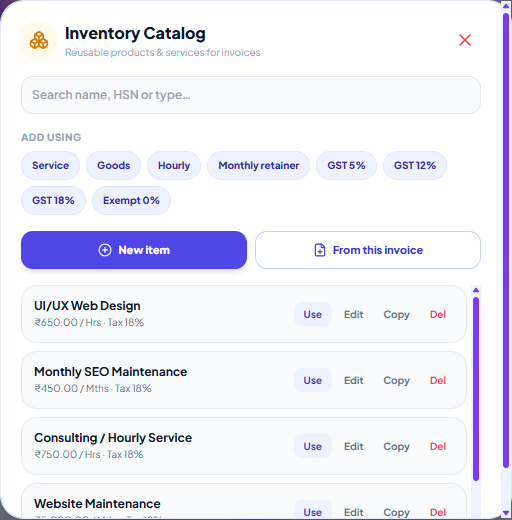
Open Inventory from the top menu. Each catalog item stores everything an invoice line needs:
- Item name and description
- SKU (your code) and HSN/SAC (the tax code)
- Default rate, unit (pcs, hrs, kg, service), and GST percentage
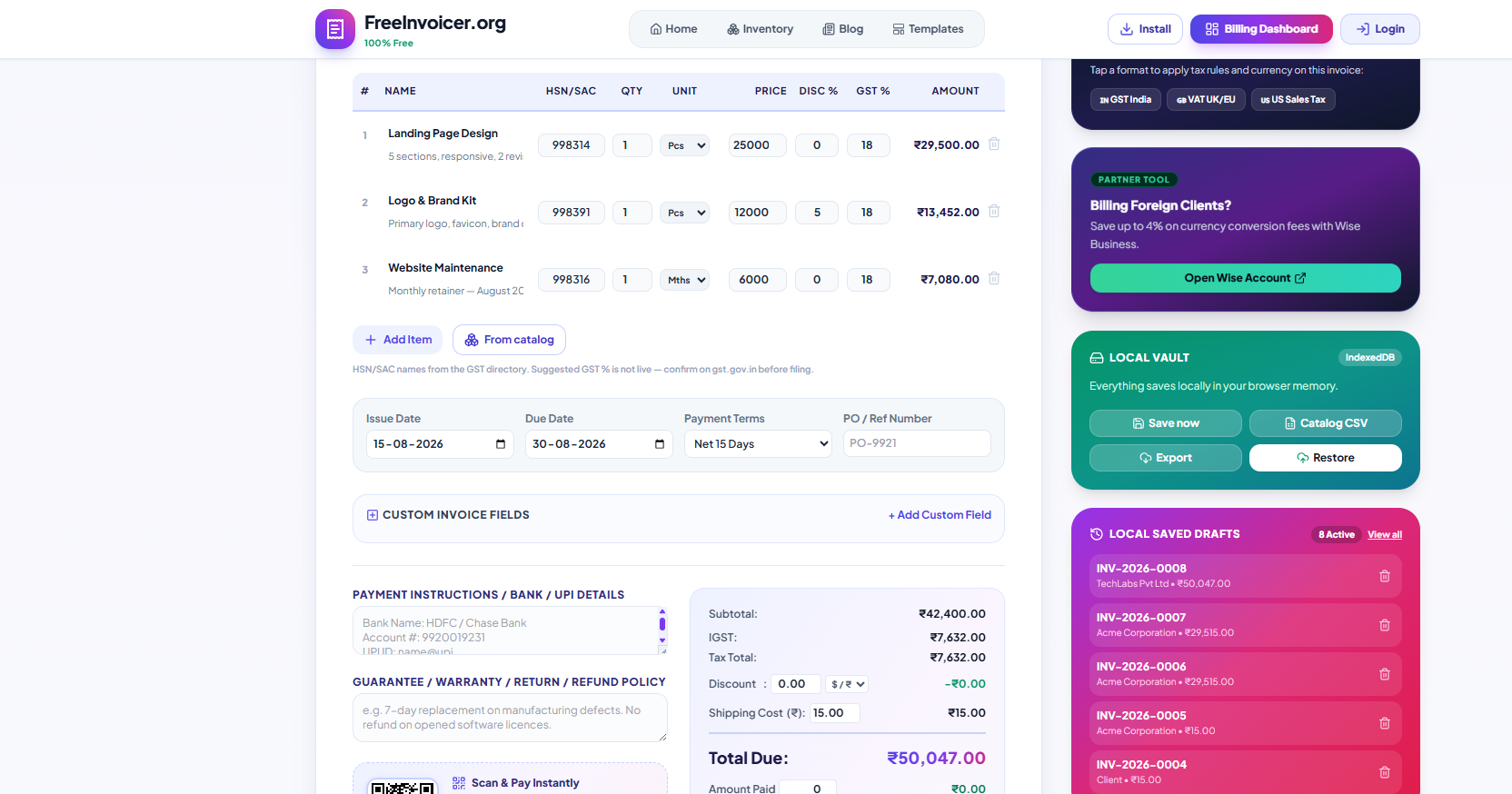
When you build an invoice, insert the item from the catalog and every field fills itself — description, codes, rate, tax. The payoffs compound:
- Speed. A ten-line invoice for a regular client becomes ten clicks, not ten paragraphs of typing.
- Consistency. The same item is always described the same way at the same rate — clients notice discrepancies, and so do auditors.
- No forgotten HSN codes. The code travels with the item, so GST compliance happens by default.
- It is local and free. Like everything else, your catalog lives in your browser's vault, included in JSON backups.
Should service businesses bother with SKUs?
Yes — think of them as productized service codes. A designer might keep LOGO-STD, LOGO-PREM, and BRAND-FULL as catalog items with fixed rates and SAC 998391 attached. Three benefits: quoting gets faster (pick the package), scope stays fixed (the description is standardized), and your quotes convert to invoices without rewriting. Freelancers who productize even three offerings invoice measurably faster than those writing every line from scratch.
A realistic before-and-after
Consider a small electronics shop billing a regular B2B buyer. Without a catalog: the owner types "USB-C cable 1m braided" from memory — sometimes as "Type-C cable", sometimes at ₹249, sometimes ₹259, occasionally forgetting the HSN. The buyer's accountant queries the inconsistencies twice a quarter, and each query delays a payment. With the catalog: the item exists once as CBL-USBC-1M, HSN 8544, ₹249, 18% GST. Every invoice line is identical, the buyer's system auto-matches the description, and queries stop. Multiply that by forty catalog items and a year of invoices, and the boring little SKU discipline quietly saves days of admin.
Keeping your catalog safe
Your item list is business infrastructure — treat it like the asset it is:
- It is included in the JSON backup. The one-click backup covers drafts, clients, and the catalog. A monthly export means a stolen laptop costs you hardware, not data.
- Prune it twice a year. Discontinued items should be removed or renamed with a
ZZ-prefix so they sink to the bottom of any sorted list instead of getting picked by mistake. - One person owns naming. If two people invent SKUs independently, you will end up with
TEE-BLK-MandTSHIRT-M-BLACKfor the same shirt. Agree on the pattern once and write it down.
Common questions
Should the SKU print on the client's invoice?
For B2B clients who reorder, absolutely — "please resend 50 × TEE-BLK-M" is the easiest purchase order you will ever receive. For one-off retail clients it is harmless either way.
Is a SKU the same as a barcode?
No. A barcode (EAN/UPC) is a machine-readable global number, usually assigned via GS1. A SKU is your human-readable internal code. Many businesses use both; small sellers usually only need SKUs.
Can two businesses use the same SKU?
Yes, and it does not matter — SKUs only need to be unique within your own catalog. That is precisely what makes them flexible.
How many catalog items should I start with?
Start with whatever you billed in the last month — for most freelancers that is five to ten items, for a shop maybe thirty. Do not try to catalog your entire universe on day one; add items the first time you actually invoice them, and within a few weeks the catalog covers ninety percent of your real billing. The goal is speed on repeat lines, not a museum of everything you might ever sell.
Keep going: the freelancer invoice checklist shows where item lines fit in the full document, and the payment terms guide gets those invoices paid faster.